First Covenant Foundation
Covenant Connection
An Alternative to
Institutional Noahism
By James Regehr, PhD, ThD
James Regehr, who lives in Canora, Saskatchewan, Canada, writes to us as an "officially recognized and certified Noahide Righteous Gentile who has since converted to Judaism."
Dr. Regehr has submitted an original essay for publication and we are printing it to provoke thoughtful discussion. Expect follow-up. The author's opinions as expressed within are his own.
[Attached Preamble, first stage: Wikipedia article - "Noahidism"] Outside the Talmud and some ancient rabbinic writings, the earliest mention of the Seven Noahide Laws is credited to RAMBAM (Maimonides, Rabbi Moshe ben Maimon, 1135-1204) in the Mishneh Torah. Starting in the 1990's, a movement developed, advocating for the Seven Laws as the core of a Universal Judaic Religion for Non-Jews, under the supervision, guidance and control of Orthodox Rabbis.
[Second stage of Preamble, Facebook essay, by Russell Kirk:]
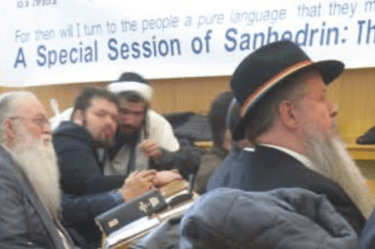
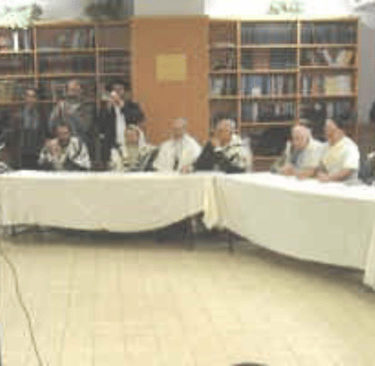
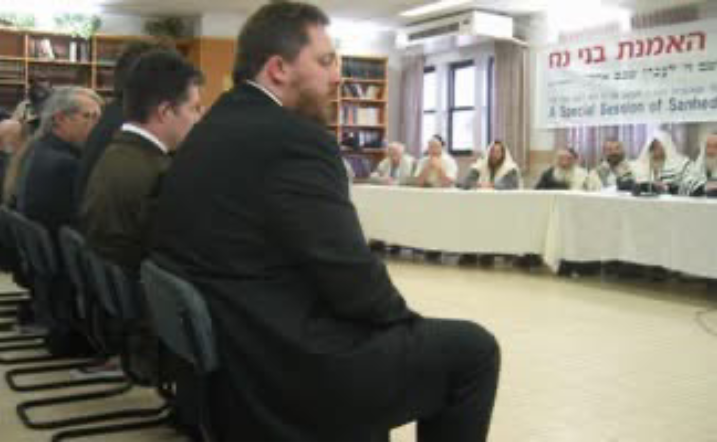
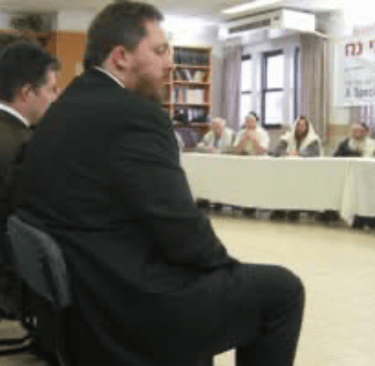
The early 2000s marked a moment that could have reshaped the future of the righteous among the nations. There was real momentum. There were real meetings. The images from those gatherings are not symbolic. They are historical. Noahides sat together with members of the nascent Sanhedrin in Israel with the stated goal of establishing a judicial framework for the Bnei Noach. This was not theory. It was an attempt to give form to the Noahide command of dinim, the obligation to establish courts of justice.
Yet what should have become a foundation became a fracture point.
Instead of producing enduring institutions, the effort dissolved into politics, competing visions, and personal agendas. Leadership became fragmented. Individuals used the moment to promote their own authority, their own definitions, and their own direction for what the Noahide identity should become. What stood before them as a historic responsibility was reduced to internal division.
This failure is not minor. It strikes at the core of the Noachic covenant itself.
Among the Seven Laws, dinim is unique. It is the only positive command given to the nations as a society. It is not optional, and it is not theoretical. It is the structural command that ensures the enforcement of the other six. Without courts, the Noahide framework remains morally aspirational but legally incomplete. A covenant without a system of justice cannot sustain itself in the public sphere.
And yet, more than three decades after the modern revival of the Noahide movement, and nearly a generation after those early Sanhedrin engagements, there is still no broadly recognized, functioning Beit Din for the nations.
Vendyl Jones helped reignite the awareness of the Noachic covenant in the modern world. Rabbi Yoel Schwartz served as a central rabbinic voice and was identified with efforts to establish a court framework for the Bnei Noach. But after his passing, there has been no clearly recognized successor who carries that mantle with the same visibility and authority. The institutional continuity that should have followed never materialized.
This raises a difficult but unavoidable question.
Why has the one command that requires structure, authority, and public implementation been left without structure, without authority, and without implementation?
The answer is not that the command disappeared. The answer is that responsibility was deferred. Some waited for rabbinic leadership to build it. Others assumed the time was not yet right. Still others attempted to claim leadership prematurely, further fragmenting the effort. The result is the same: delay, stagnation, and absence of a unified judicial framework.
But the command of dinim does not wait for perfect conditions.
If anything, the lesson of those early meetings is not that the effort should be abandoned, but that it must be approached differently. The foundation cannot be built on personalities. It must be built on structure, humility, and submission to authentic halachic guidance. It must grow in stages, with seriousness and discipline, rather than ambition and self-appointment.
The images from those meetings stand as both evidence and warning. They testify that the opportunity was real. They also testify that opportunity alone is not enough. If the righteous among the nations are to fulfill their role within the Noachic covenant, then the responsibility cannot remain indefinitely postponed. Courts of justice are not someone else’s command to fulfill on their behalf. They are part of their own obligation.
The question is no longer whether it should have been done. The question is whether it will be done now, and whether it will be done correctly.
____________________________
[Dr. James Regehr, "An Alternative to Institutional Noahism." This is the essay at the heart of this issue - a "think-piece" worth discussion:]
1. They had the goal of establishing a judicial framework for the Bnei Noach.
2. They had the goal of establishing a Beit Din for the Nations based on authentic halachic guidance.
3. They said that the establishment of Courts of Justice falls on the righteous of the Nations.
Contrarily, the very nature of the Sheva Mitzvot (Seven Laws), is that they were given to be universal for all mankind—not just for the “righteous gentiles.” In fact, the imperative is that the unrighteous pagans of the nations are the ones who are obligated to follow these Mitzvot!
To establish a Beit Din sponsored by Noahides or the Sanhedrin imposes an obvious Judaic bent when it is based on authentic halachic guidance. However, this completely undermines the integrity and legitimacy of the existence of the nations as distinct from Bnei Yisroel.
While on one hand, as stated, without courts, the Noahide framework remains morally aspirational but legally incomplete, on the other hand, in the absence of authentic halachic guidance, the Nations must grapple with and articulate exactly how the Sheva Mitzvot are to be expressed in their specific ethnocultural national identity.
Even as it has been said that the Torah was written without vowels in order to both allow and foster differing understandings, perspectives and interpretations, so also the Sheva Mitzvot must be kept devoid of “authentic halachic guidance” in order that each people may understand, interpret and express the Mitzvot in their own way.
There must, therefore, be no centralized, sanctioned, judicial framework for Bnei Noach; no halachic Beir Din, and the establishment and control of the Courts of Justice must remain in the purview of the “unrighteous” nations themselves!
The Sheva Mitzvot, however, form the moral aspiration of the nations but they do not encapsulate nor even reflect humanity’s responsibility to God. The Sheva Mitzvot are not about serving God as much as they reflect some basic morality, when it comes to God, and humanity’s responsibility to one another and Creation.
The Sheva Mitzvot express the basic principles of how people are to get along with God, Creation and one another, but the Sheva Mitzvot fall short because they do not express what is truly important.
Hoshe’e HaNavi (Hosea, the Prophet) emphasizes the original and most foundational covenant God has ever made with humanity and he refers to it as the Covenant With Adam, man, all humankind.
Hosea said, “I want you to love Me rather than just sacrifice to Me, I want you to know Me more than I want your burnt offerings. But, like Adam, you broke My Covenant and betrayed My trust. (Hosea 6.6-7)
God’s Covenant with Adam was and remains for us to KNOW God and to LOVE God.
While this Covenant is echoed time and again throughout Torah, the Nevi’im (Prophets) and the Ketuvim (Writings), of Biblical Hebrew Scripture (the Hebrew Bible), in places like the Shema (Israel's call to faith) and elsewhere, knowing and loving God can neither be qualified nor quantified and therefore cannot be regulated, dictated, adjudicated or controlled by authentic halachic guidance.
While some may insist that one can know God through studying Torah, others might say that one cannot know God simply by studying Torah but can only know God by performing His Mitzvot. Dao’id HaMelek, King David, in Psalms 46.10 wrote: “Be still to know that I am God,” suggesting that the only way to get to know God is in quietness and solitude.
To be fair, studying Torah is very good and one is able to know much ABOUT God from it. Similarly, the performance of His Mitzvot is also a way to know ABOUT God … but knowing God is something very different!
Indeed, even the New Testament writer, Paul, told the people of Athens the following:
The God who made the world and everything in it, being Lord of heaven and earth, does not live in temples made by man, nor is He served by human hands, as though He needed anything, since He, Himself, gives to all mankind life and breath and everything. And He made from one man every nation of mankind to live on all the face of the earth, having determined allotted periods and the boundaries of their dwelling place, that they should seek God, and perhaps feel their way toward Him and find Him. Yet He is actually not far from each one of us, for “‘In Him we live and move and have our being," as even some of your own poets have said. Christianity's Scripture, Acts 17.24-28
Similarly, invitation after invitation is given for us to seek God with all our heart if we want to find Him.
Jeremiah 29.13 says, “You will seek Me and find Me, when you seek Me with all your heart.”
1 Chronicles 28.9 says, “If you seek God, He will be found by you.”
Long before there was any such thing as “organized religion,” there was God.
Adam and Eve walked with God in the Garden of Eden and talked with Him Face to face as friends. (Genesis 3.9-11).
Enoch walked with God and God took him, (Genesis 5.24).
Noah found grace in the Eyes of the Lord and walked with God, (Genesis 6.8-9).
Isaiah 41.8 says that Abraham was God’s friend and God used to go to Abraham’s home and visit with him— face to face. According to Genesis 18, God (by His angels) even stayed for supper and ate in Abraham’s home with him.
According to Genesis 32.30, Jacob spent time with God virtually "Face to face" and actually ended up physically struggling with God, but they talked and worked things out between them.
Moses used to speak with God "Face to face," Exodus 33.11 says, "as a man talks with a friend."
In those ancient times, Psalm 145.18 says that God drew near to all who would call on Him, and going back to the very earliest of times, even at the time of Seth, the son of Adam and Eve, Genesis 4.26 says that people began calling upon the Name of the Lord.
This is God’s Covenant with Adam—to KNOW Him and to LOVE Him.
As Noahides, it is not your job to form the courts of justice in your land. Courts of justice already exist in every land. They have been established by the people of their lands.
It is the job of the Noahides not to overturn or replace the courts of justice in each land but rather to do what they can to correct or prevent every travesty of justice the courts permit.
It is true that the court and judicial systems of many lands have become corrupt an ineffective. Noahides need to be a voice to help restore their integrity and purpose!
The courts of justice commanded in the Sheva Mitzvot are not religious courts. They are to be the civil courts for that is the place where justice must be present.
The Sheva Mitzvot do not the framework of a religion form. The Sheva Mitzvot are the universal laws for all humanity.
The “religion” of the righteous gentile must be the Adamic Covenant, which contains neither sacrifices, offerings nor sacred rites. It does not utilize any specific prayerbook Siddur nor hymnal. It does not honor festivals or moedim (seasonal holy days) except the recognition of God’s blessing of the Sabbath as a special day each week - although no black letter imperative was given to Adam regarding him remembering to keep the Sabbath holy.
Therefore; being Noahide at present is best described as non-Jews striving to live under the authentic halachic guidance of Jewish Rabbis rather than simply following the Sheva Mitzvot. However, while the Sheva Mitzvot are universal laws for humanity to get along with God and one another, they are not God’s primary covenant with humanity.
It is God’s primary goal the the nations of the world will come to know Him and to love Him.
This job was not given to the Noahides. It is our Jewish sacred duty. We are the ones He has chosen to tell the nations how they can know God for themselves.
Yes, God has told us much about Himself in our Bible but that is not the only way to come to know God! He can be known through Creation itself. He can speak to people through dreams. There are no limits to the number of ways that people can know and experience God!
Maybe, as Jews, we should focus our efforts less and less on Noahides and the Sheva Mitzvot and more and more on helping the nations know God!
By James Regehr, PhD, ThD
What do you think? We'll discuss the points raised here in later issues. We welcome your input.
MD
Detroit
June 11, 2026
_________________________________________________________________________________________ He has told you, O man, what is good, and what the LORD (HaShem) demands of you: Only to do justice, to love loving-kindness (chesed), and to walk humbly with your God." - Micah 6:8


Volume 19.4 FINAL VERSION
June 2026/Sivan 5786
Photos from "a Special Session of the Nascent Sanhedrin," in Jerusalem. In the top photo, our late great friend Jack Saunders, with the healthy white beard, is seated left. We've been friendly for a long time with lots of the people there.
Subscribe to Covenant Connection Today
Get inspiring insights and updates straight to your inbox

Get in
Touch with us to share your thoughts or questions.